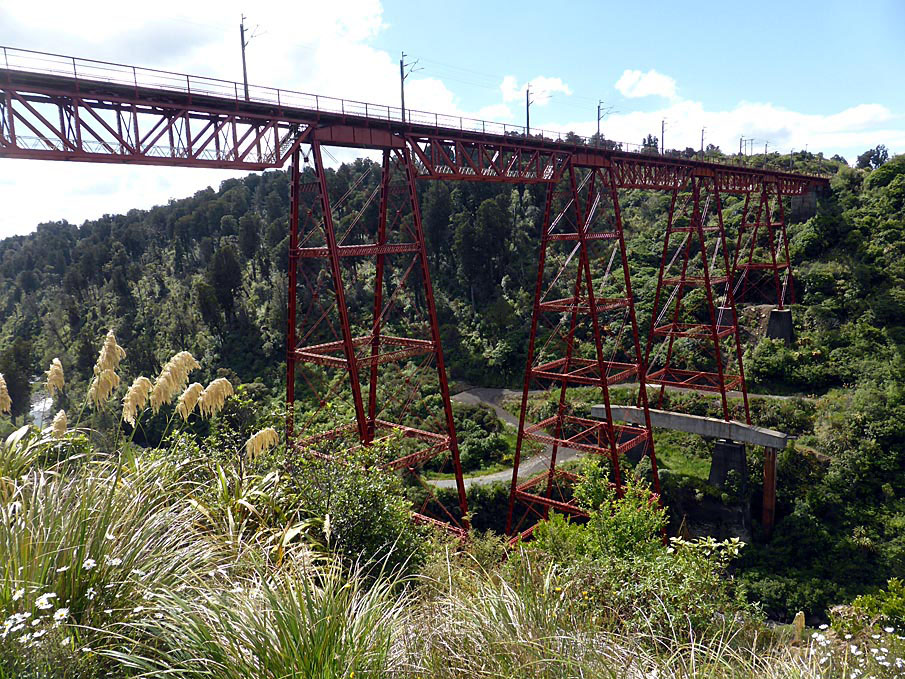
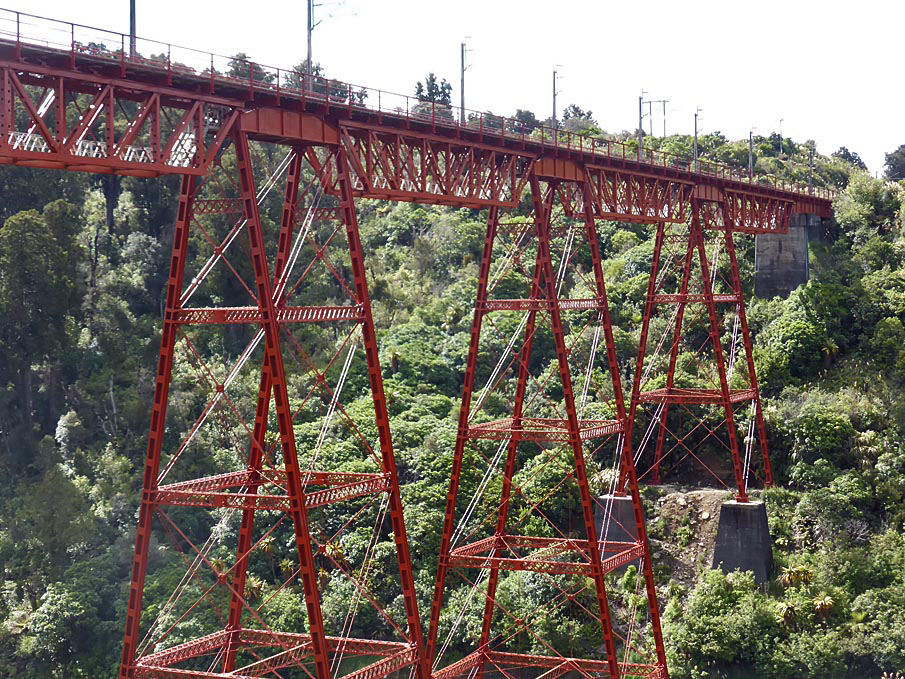
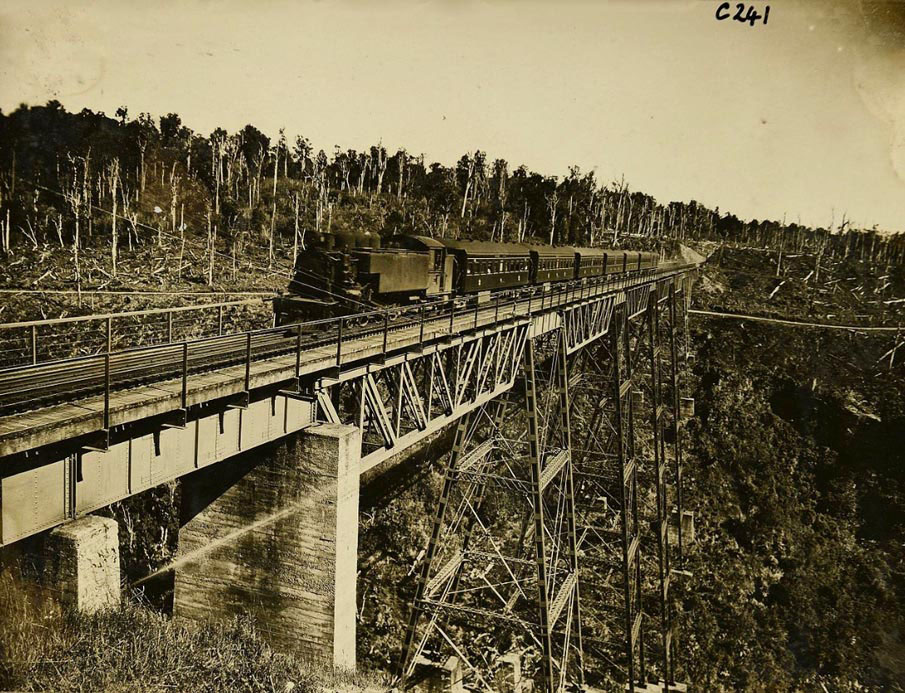
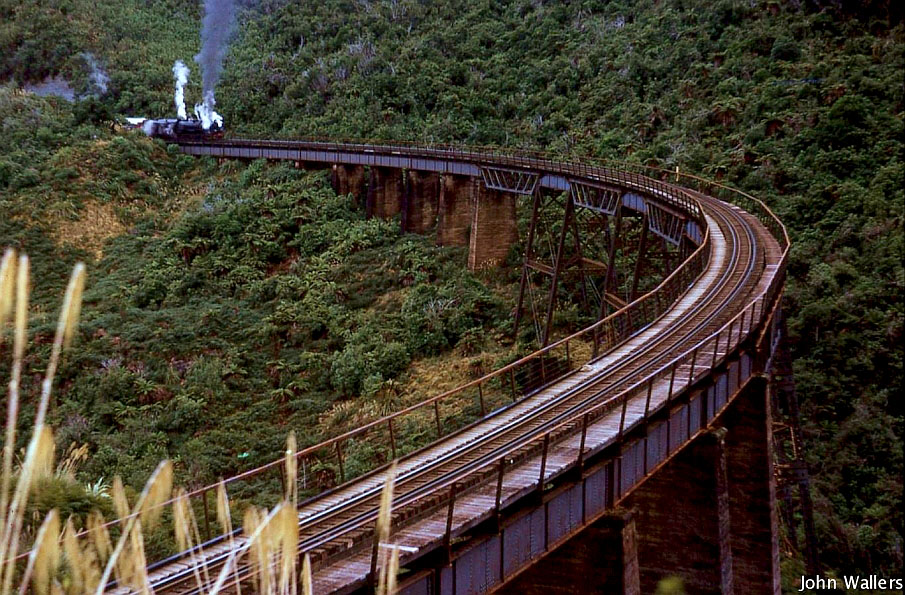
The Makatote Viaduct, built between 1905 and 1908, is one of the engineering icons of the North Island Main Trunk (NIMT) and bridges the Makatote River between Pokaka and Erua in the North Island's picturesque Central Plateau. It was the last structure built on the NIMT and was therefore vital in the 'final push' to complete the railway.
Settlement through sleepers and steel:
The completion of the NIMT in late 1908 is described as '...one of the pivotal moments in New Zealand history' and '...arguably the New Zealand state's greatest achievement, at least in the first century after 1840, and certainly its greatest financial commitment.' The impetus for the NIMT was the need to create a direct link between New Zealand's two major cities, Auckland and Wellington. For 20 years prior to the NIMT's completion, goods and passenger traffic between these cities was typically directed from Auckland to New Plymouth via coastal shipping, then continued by ship or train onto Wellington and vice versa. However, another motivator for the railway was for it to act as a means of Europeans gaining access to the sealed-off King Country, or Rohe Potae, and in turn establish settlements which could support the railway and exploit the vast, and relatively untouched, resources of the Central Plateau region.
From the mid-1860s Maori in the central North Island had repelled European encroachment by establishing, and staunchly upholding, the restricted area known as the Rohe Potae. After a decade of persistent approaches from the government regarding the area, talks between officials and some King Country chiefs regarding the establishment of the railway through their land began in earnest in 1883. A series of rigorous negotiations was then initiated with two Ngati Maniapoto leaders, Wahanui Hautare and Rewi Maniapoto.
In late 1884 Wahanui announced his intention to cooperate with the government regarding the railway, and he laid out a set of conditions before the House of Representatives on 1 November 1884. He did this because he wanted any European encroachment into the area to be on iwi's terms, which included the right of the King movement to manage their own affairs, the banning of liquor from Waikato-Ngati Maniapoto territory, the right of his people to have sole responsibility for administering their ancestral lands, and that they were compensated for the land which was used. Following this, in early 1885 surveyors were allowed into the Rohe Potae to locate possible railway routes. Because of the tenuous relationship between the Crown and King Country iwi it was felt that the negotiation process was essential. However, by only consulting with Wahanui and Maniapoto the government purposely side-stepped King Tawhiao and other leaders who opposed the railway. Therefore, this initial agreement was not universal and accordingly there were instances of resistance, such as the destruction of surveying marks.
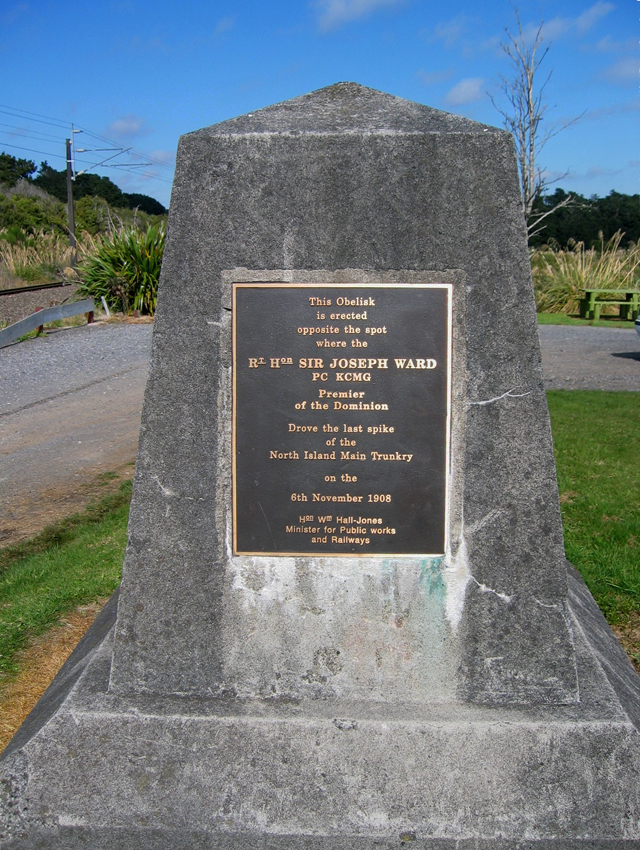
Despite some opposition, surveying and construction plans continued and on 15 April 1885 it was Wahanui who wielded the shovel that turned the NIMT's first sod, which was then ceremonially wheeled away by Premier Robert Stout. Prior to the chiefs allowing surveyors into the Rohe Potae, possible railway corridors through the King Country were only speculative because there had not been any previous opportunity to map it in detail. There were several proposed routes for the NIMT and John Rochfort (1832-1893) surveyed for a possible corridor through the Central Plateau between 1883 and 1887. This was said to be his tour de force because he had to start from scratch and cover a large, and topographically complex, area. Rochfort must have spent a significant amount of time around the Makatote Gorge because he built a hut. This hut, referred to as ‘Rochfort's old whare,' was close to the Makatote Viaduct site and was still in use 20 years later. After much debate and delay it was Rochfort's route for the NIMT that was eventually followed. The Maori land that this route required progressively passed into Crown ownership under the Public Works Acts of 1882 and 1894. This legislation stipulated that construction could not begin until the governor issued a proclamation detailing the middle-line that each successive section would take.
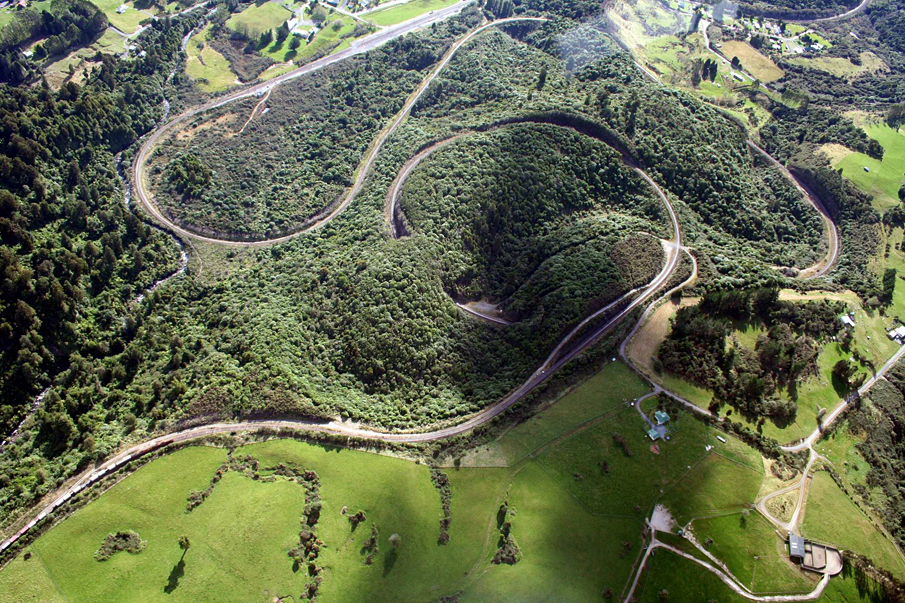
Once the route was resolved and the required land obtained, the construction progress of the NIMT laboured along, taking 23 years to complete due to various political and financial impediments including the depression of the 1890s. By 1900 public dissatisfaction over the prolonged construction period motivated parliament to inject significantly more resources to the project, and facilitating a final flurry of activity to see the last section between the Makohine Viaduct and Taumarunui completed. Within this area the section between Ohakune and Raurimu, in particular, was no easy task despite the boost in funding and manpower, because of the rugged terrain which was noted for its steep grades, deep ravines, and heavy bush, not to mention the often inclement weather. Given the topography it is not surprising that this ‘final push' section has a concentration of significant structures. These include the Makatote and three other surviving viaducts, and important earthworks of which the Raurimu Spiral is an internationally recognised engineering achievement.
The Makatote Gorge is a prime example of the deep ravines which scar the landscape west of Mount Ruapehu and in 1903 it was described as:
...a deep and narrow gorge to be spanned with a great viaduct - a giant ravine that will never grow anything but the rimu, matai, maire, and under-growth with which its precipitous sides are now clad. The bush in this wonderful gorge...will constitute one of the principal attractions of the Waimarino section of the Main Trunk line.
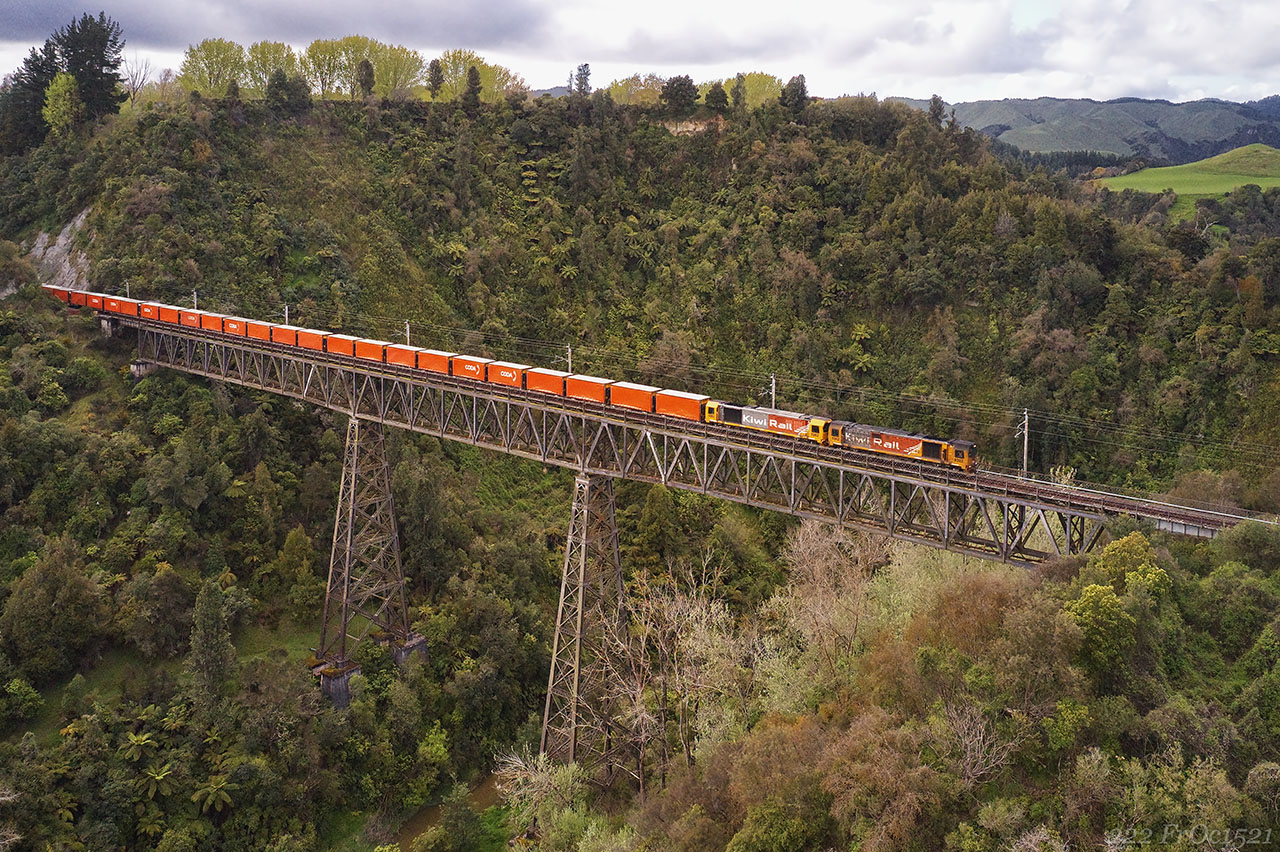
At some points the depth of the gorge is approximately 300 ft (92m), but a lower point was chosen for the site of the viaduct which means it is 258ft (79m) tall. Even so, until 1981 the Makatote Viaduct was the highest structure on the NIMT, and is currently the third tallest viaduct in New Zealand. The monumentality of the viaduct and its setting within an equally dramatic landscape ‘...commands considerable awe - perhaps more than any other New Zealand railway structure.'
Bridging the gap: Constructing the Makatote Viaduct:
The Makatote Viaduct looms up from unseen depths with its five tapering piers of rigid steel...This structure has often been described both in these columns and elsewhere, and photographs of every stage of its erection are to be seen. Yet no pictures and no descriptions can reduce it to a commonplace. It stands, and it will stand, it is hoped, for many years as our finest monument of structural engineering. It ranks in height among the great viaducts. In the beauty of its situation it acquires enhanced significance.
The Makatote Viaduct, and its other NIMT contemporaries, are products of the iron and steel construction age of the late 19th and early 20th centuries which saw the building of iconic structures such as the Crystal Palace (1851), and Gustave Eiffel's steel viaducts and Eiffel Tower (1889). The industrial revolution demanded the development of construction materials which were long lasting, relatively light, and could be mass produced, and iron and steel fulfilled these criteria. However, it was not until the late 19th century that a technique was developed which reduced the cost of steel production and made it as cost effective as iron. As a consequence of the international railway boom engineers, such as Eiffel, pioneered the construction of steel viaducts. From this period, steel fabrication was favoured for viaducts, and other large self-supporting structures. In particular, lightness was important for viaducts ‘because it is only in such structures that the weight of the metal forms a prominent item in the strains.' Consequently, the Makatote Viaduct was constructed using steel and was described as an ‘Eiffel Tower among viaducts' because of its monumental scale and trestle construction. Aside from being constructed in steel, the lightness of the Makatote is said to also be a tribute to the ‘skilful and bold work of its designer.' The fabric and design of the Makatote Viaduct makes it a characteristic structure of the period, although it is an extraordinary example because of its impressive scale.
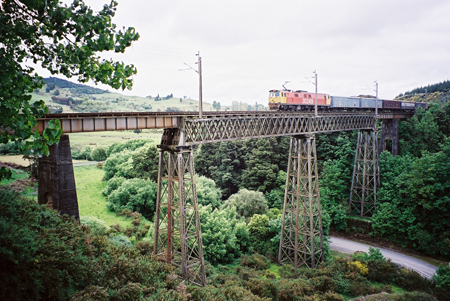
The engineer responsible for designing the Makatote Viaduct, and many other dynamic NIMT structures, was Peter Seton Hay. Hay is noteworthy because he was the first person to graduate from the University of Otago with a Bachelor of Arts in 1877. He then joined the Public Works Department (PWD) and gradually progressed through its ranks to become the engineer-in-chief by the time he died prematurely in 1907. Hay's designs for the NIMT construction era Makohine, Mangaweka, Hapuawhenua, Taonui, Manganui-o-te-ao, Mangaturuturu, and Makatote viaducts were all based on classic North American trestle viaducts and are recognised, alongside his pioneering research into New Zealand's hydroelectric capabilities, as his most important legacies. The Makatote's design is derived from the one Hay used at Mangaweka, which differed from Makohine because it included plate girders over the piers which were interspersed with lattice truss spans to create a more visually pleasing structure. The Mangaweka Viaduct was demolished when the Mangaweka deviation was built in the early 1980s. This means that the Makatote Viaduct is the only remaining large scale Hay viaduct of this design. Hay is said to have made his first and only visit to the Makatote construction site while taking a general tour of the works in the area. On this occasion, Peter Keller, a young up-and-coming engineer with the PWD, recorded that ‘the weather was atrocious and he [Hay] got a real soaking.' Apparently, Hay already looked ill and died of pneumonia not long after this visit, which unfortunately meant that he did not live to see the Makatote Viaduct, one of his finest achievements, completed.
Although some preliminary site work was done by the PWD, the Makatote Viaduct was constructed by a private engineering firm from Christchurch, J & A Anderson Ltd. This company was awarded the contract for the large sum of £53,369 in 1905 and the plans were signed-off at the end of June. The letting of the contract for the ‘largest work of its kind carried out in New Zealand by private enterprise' to that date, was well in advance of the railheads reaching Makatote because it was recognised that in order for the NIMT to progress steadily significant structures needed to be complete by the time track was laid up to them. Andersons was a well established firm, and was awarded the contract on the basis of their previous experience constructing railways and viaducts in the South Island, and also on the NIMT having built the Te Kuiti to Mokau section 1887-89, which included the Waiteti Viaduct.
The construction of major projects, such as the Makatote Viaduct, relied on a huge amount of manual labour, so communities sprung up around them. In general the advent of the NIMT injected Europeans into the area, but also affected the demographic spread of the region's pre-construction population. In particular, it has been noted that after 1900 the various Maori settlements around the Manganui-o-te-ao River were depopulated. This is because many gained employment as labourers on the NIMT and then gravitated towards the newly established European towns once their work was completed. Therefore, until construction for the Makatote Viaduct began, there was no existing substantial permanent settlement within the immediate vicinity of the viaduct site. There was a settlement at the north end of the viaduct and is it reported to have included the workers tents and huts and ‘a sprinkling of accommodation houses, stores, and refreshment rooms, all of the primitive architecture characteristic of the transitory township....' It is estimated that there were approximately 400 to 500 people living around the Makatote site, most of who worked on the viaduct and were immigrants from Britain or Australia, in accordance with Vogel's plan. The size of the community was relatively large for the region at this time, even compared with established permanent settlements. For example, Ohakune's population in 1908 consisted of approximately 600 people.
As well as the temporary tent and hut accommodation used by the workers, Andrew Anderson, the junior partner of the firm, built a house on site for he and his family to live in from 1906 until the viaduct's completion. Andrew's nieces visited often and the high profile of the family and the project was demonstrated by their comings and goings being reported in society pages. The Andersons' house, next to the Makatote workshop, seems to have been the social centre of the community with dinner parties and the hosting of guests. Laura Anderson, the wife of Andrew, had pre-planned for the site's isolation by stocking up on essential supplies like first aid equipment and taking courses before leaving Christchurch. Because of this foresight she became the first port of call for medical treatment in the community.
The size of the Makatote community fluctuated depending on the phase of construction and increased late in the construction period because of the sense of urgency to get it completed in time for the late 1908 deadline set by the government. One of the first injections of labour was during the building of the access road by the PWD, which because it was not started early enough delayed proceedings by at least 6 months. Other special facilities also needed to be built, such as a workshop for the fabricating of the superstructure. The Makatote workshop was situated immediately north of the viaduct, featured cutting edge machinery for the time, and was fully electrified. Temporary onsite workshops were standard practice for Andersons and had been an aspect of PWD viaduct projects like the Makohine. However, because of unsuitable site access at Makatote it was necessary to manufacture all the steelwork on site. Therefore, the Makatote workshop (built 1905-06) was more elaborate and larger, at 285 x 30ft (87 x 9m) in size, than their previous ones and was also used for the manufacturing the superstructures of the two other Andersons constructed viaducts in the vicinity.
Unlike planned towns along the NIMT, Makatote was not meant to be permanent, so upon completion the workshop and accommodation structures were dismantled. The Makatote community, therefore, was a significant example of the fluid and transitory nature of the population in the district between 1900 and 1908. Because the community disbanded this means that the viaduct is the only remaining complete physical remnant and tribute at the site to what was the intense manual labour effort to complete it and the NIMT.
During construction there was huge public interest in the progress of the NIMT, and Makatote in particular, and as such we find numerous and lengthy descriptions of it in newspapers. One article from June 1907detailed the ingenious technique used by Andersons to tackle the challenge of erecting this high viaduct:
The marvel to the lay mind is that these huge steel girders are being placed in position by swinging them out in the blue ethereal on 2 ½ inch wire rope...Objects are swung out by attaching them to a wheel and pulley arrangement working along the wire and called a traveller, or, more picturesquely, a Blondin. A winding engine works the Blondin backwards and forwards, and when the Blondin is over the desired spot, its freight is lowered to the level required. Sometimes a bucket with a human freight is attached to the Blondin. What must it feel like working 200 hundred odd feet in midair, with enough drop beneath you to accommodate two Grand Hotels one on top of the other, or three Government Buildings?
The ‘picturesque' name for the technique was taken from the famous French Niagara Falls tightrope walker, Charles Blondin. This technology was essential to the completion of the viaduct as it overcame the difficulty of building a tall and reasonably long viaduct in an unsympathetic landscape.
Construction of the viaduct began in mid-1906 with the clearing of the bush and excavating for the piers. However, aside from the delay caused by the late construction of the service road, Andersons faced other problems. Difficulties posed by the landscape were overcome using the Blondin, but the biggest hindrance during construction was the weather. For example, it was reported that in September 1907 there was no fewer than 28 rainy days at Makatote. Also, on at least one occasion in 1906 the river flooded which resulted in the destruction of the flume and delayed work by several weeks while it was repaired. Another cause of delay was geological because pier 7/G was found to have a ‘rotten foundation.' This was overcome by driving the footing deeper into the ground. However, the time taken in gaining permission to change the plan and in undertaking the additional concrete work affected the progress of erecting the piers. Aside from these factors workers, many of whom lived in tents or flimsy wooden PWD huts, had to contend with freezing winter temperatures and treacherous work conditions which for seven men resulted in death after they slipped off the icy steelwork. These challenges meant that the contract eventually ran one year over the stipulated time, and incurred some criticism from anxious politicians and the public.
The actual structural work for the viaduct dates from August 1906 when the northern-side concrete piers and pier footings were poured so that work could begin on erecting the steel piers. This meant that by February 1907, piers 811/H-K were constructed, however, the foundation work for the piers on the opposite bank had only been started the month previous. Around this time F.W. Furkert succeeded J.J. Hay as Resident Engineer for the area, and the significant construction progress during 1907 was attributed and his drive, efficiency, and management skills. Indeed, from mid-1907 work at Makatote, in particular, seems to have progressed well with most of the piers completed and some of the spans in place by the end of the year. It then remained to complete pier 5/E and 6/F, the highest central pier, which was done by the end of January 1908. Work then began on positioning the girders using the Blondin as described previously.
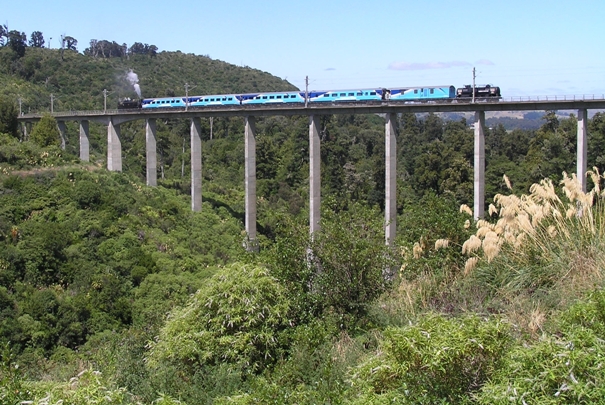
By late April 1908 the NIMT railhead was north of Makatote, which meant that all that stood in the way of the NIMT's completion was the viaduct. The last girder was placed in position on 7 June, with final touches completed soon after, such as coating the steelwork with haematite paint. Andersons declared the viaduct finished on 10 July 1908, and later that month a weight test was made using temporary tracks. Essentially all that was then needed was for the permanent track to be laid across it be the PWD. This had not been completed by the time the ‘Fleet Special,' otherwise known as the ‘Parliamentary Special,' train was due to make the inaugural uninterrupted train journey from Wellington to Auckland on 8 August 1908. This train stopped on the Makatote Viaduct, which seems to have been a particular highlight for the Premier Sir Joseph Ward. The clear day meant that he and the other passengers were afforded a view of Mount Ruapehu in one direction, and Mount Taranaki in the other.
Maintaining an image: The Makatote Viaduct post-construction:
The tremendous interest in the Makatote Viaduct during its construction carried on once the NIMT was complete and because of people's fascination with the structure there is a plethora of images available of the viaduct. The Makatote Viaduct became a ‘pin-up' structure for the Railways Department NIMT advertising campaigns from the 1940s to mid-1970s and, among other things, it featured in the cover image for the NIMT's 50th anniversary pamphlet. Over the years it has also been a source of reverence and interest among rail enthusiasts and tourist alike and many images have resulted. Among numerous accolades it has been said that: ‘Without doubt the Makatote is an engineering masterpiece of its time, a truly impressive structure built in harmony with its bush environment.'
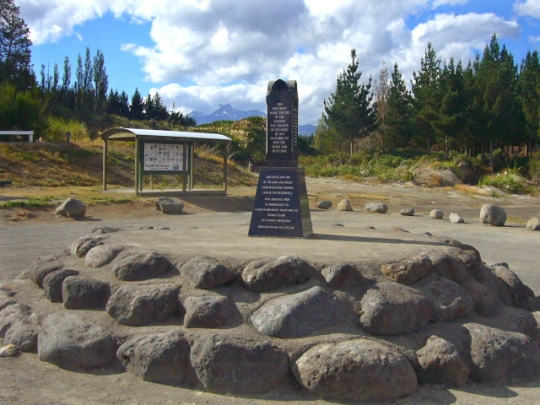
Even before it was completed, the aesthetic qualities of a viaduct set within such a dramatic landscape were appreciated and this eventually led to the establishment of the Makatote Scenic Reserve to the north of the viaduct in 1914. In 1977 it was estimated that ‘approximately one in ten cars stop at this viewpoint [the Makatote Scenic Reserve] to either picnic or view the viaduct, and of these cars approximately 50% of the people alight and take in the general scenery.' The cavalcade of cars and people lining the banks of the Makatote Gorge in order to glimpse the NIMT Centenary Celebration ‘Parliamentary Special' crossing the viaduct in August 2008, and also the release of a Makatote Viaduct stamp by New Zealand Post, is evidence of the continued appreciation for Makatote as an engineering feat and aesthetic highlight of the railway and state highway.
Railway structures, like the Makatote Viaduct, were built and operated based around the principle of continuous improvement and repair when needed. Therefore additions and alterations to the viaduct are an integral part of its, and the NIMT's, story and reflect larger historical changes in railway operations and technology. In accordance, minor changes have been made to the Makatote since 1908, including re-coating the superstructure in 1959 and partially in 1997. However, there were four main periods of significant alteration to the structure. Along with other bridges and viaducts on the NIMT, the Makatote had its spans strengthened between 1925 and 1932 to ensure it could bear the heavier class of locomotive that was being introduced. Concern for the footing of the highest central pier meant that this was underpinned in 1981-82, as well as some other remedial work. It was another change in locomotives and technology that prompted further changes in 1986. At this time the way beams which supported the track were replaced and steel brackets to support electrification masts were constructed in preparation for NIMT electrification.
The last significant addition to the Makatote Viaduct was the underpinning of pier 7/G between May 2006 and February 2007. It was about the time that pier 6/F was underpinned that assessments of the erosion at the footing of pier 7/G began. However, it was not deemed necessary to act until 20 years later. The resulting addition was important because it was done in order to maintain Makatote's structural integrity and ensure its ongoing viability as a functioning part of the NIMT. This pier had caused delay during the NIMT construction period because of its ‘rotten foundation,' and 100 years later it was causing problems again. The addition to the footing essentially transferred the strain on the pier's troublesome foundation onto the appendage which is visible from the SH4 southern rest stop. The restoration project was a collaborative venture between ONTRACK, Fulton Hogan Ltd and specialist engineering consultants to the sum of $4.2 million dollars. The price of completely replacing the viaduct would have been prohibitive when all that was needed to secure Makatote was to splint its Achilles' heel.
Considerable time was spent conceiving the best means of stabilizing the via-duct and the eventual solution to build a new support structure along side the original pier footings won ONTRACK the Supreme Award for New Zealand Engineering Excellence 2007. The work was described as an example of ‘world best-practice in retrofitting...and makes a significant contribution to the reputation of New Zealand engineering.' The success of the project gained further esteem because all the work was completed while the viaduct was still open to rail traffic, and also because the environmental impact on river and its inhabitants was a central concern.